
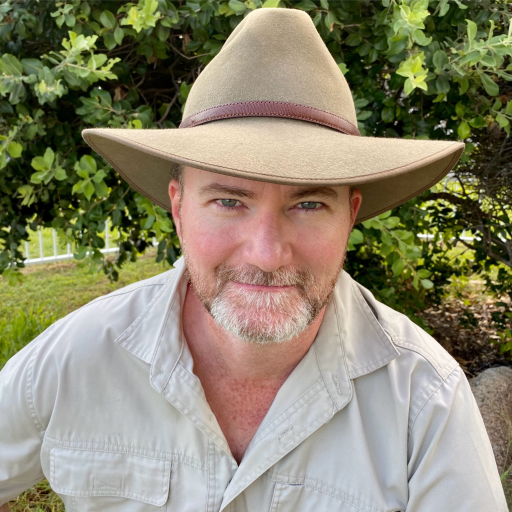
Dr. Scott Hocknull
PhD
Principal Research Fellow Applied Palaeontology & Palaeotourism
School of Health, Medical and Applied Sciences
- s.hocknull@cqu.edu.au
- ORCID: 0000-0003-4157-8434
- Working From Home
About Me
If you would like to undertake postgraduate study in applied palaeontology and palaeotourism through translational research that gives you real world experience and connection to regional organisations and fields, please contact me to discuss career pathways and projects.
I am a vertebrate palaeoecologist by training, a passionate and experienced science communicator and media talent, exhibitor, and a practitioner of 3D digitisation and virtual technologies, including multimodal imaging techniques, within the museum, heritage and palaeontological science sectors. I am recognised as a thought leader in Australia’s emerging palaeotourism industry, promoting shared custodianship of geonatural heritage and respect for the messages carried by the deep past. My objective is to advance applied palaeontology that connects deep-time research with contemporary challenges in conservation, education, heritage and sustainable regional development. I aim to embed research, training and interpretation within regional contexts, ensuring geonatural archives deliver enduring scientific, cultural and socioeconomic value to the communities from which they originate.
I study dinosaurs and Australia’s extinct megafauna to understand how ancient ecosystems worked and how animals responded to long-term climate and environmental change. I’ve been involved in the discovery and naming of some of Australia’s most famous dinosaurs, including Australovenator wintonensis, often described as Australia’s most complete meat-eating dinosaur, and four giant long-necked sauropods from Queensland. These include Australotitan cooperensis, the largest dinosaur ever found in Australia, as well as Diamantinasaurus matildae, Wintonotitan wattsi and Savannasaurus elliottorum. These discoveries come from real fieldwork in outback Queensland, in particular Eromanga and Winton, and have helped put Australia on the global dinosaur map.
I also lead research into Australia’s extinct megafauna, including the world's largest marsupials and carnivorous lizards (Komodo Dragons and Megalania) and ancient crocodilians. I work on the only known Pleistocene rainforest fauna sites in Australia at Mount Etna Caves National Park and the Capricorn Caves (Darumbal Country), that include the greatest diversity of predators, arboreal mammals and frog species so far found in Australia, with many sharing relationships with species still living today in the tropical rainforests of New Guinea. One exciting discovery included the youngest tropical megafauna site in Australia, at Bidgerley (Barada Barna Country) near Nebo, that demonstrated a diversity of megafauna species living well after people arrived on the continent 60,000 years ago. In southwest and southeast Queensland, I work on spectacular megafauna “graveyards” near Eulo, Brigalow and Dalby, where fossils of the world’s largest marsupial, Diprotodon, are preserved in large numbers, alongside strange and unique species. New collaborations in the Carnarvon Gorge are opening up new palaeotourism opportunities. Early Cenozoic fauna is also an exciting part of my research, including new species of ancient mammals, lizards, frogs, snakes and birds found from southeast Queensland and central eastern Queensland sites. Across all of this work, research students get hands-on experience in the fields of palaeontology, palaeoecology, palaeotourism and the application of these for regional development and application to conservation. Fieldwork can include everything from dinosaur and megafauna excavations and fossil preparation to 3D scanning, digital modelling and museum-based research that turns discoveries into real science and public experiences.
General
Background
My career in palaeontology spans more than 30 years and began with my first peer-reviewed scientific paper at age 16, at the time Australia’s youngest scientific author. My professional perspective has been shaped by an unusually continuous pathway: growing up in the Northern Territory, volunteering at the Queensland Museum from age 12 in palaeontology and geology collections, working as an Interpretation Officer at 17, and, in 2000, becoming Australia’s youngest museum curator at age 22. My career has been fundamentally non-academic, so I bring an industry and applied perspective to this unique university research position.
My research focuses on Gondwanan and Sahulian palaeoecology, with particular emphasis on the geobiological evolution of Queensland’s coastal and inland basins and their associated threatened environments and species. Central to my work is the application of palaeontology from local context to global relevance, informing modern ecosystem and species conservation to enabling geonature tourism, education and creative industries.
Recognising that most museum collections remain hidden from public view and concentrated in metropolitan institutions, I have become a strong advocate for bringing behind-the-scenes science to the public. I work to decentralise custodianship of fossil and geoheritage collections through collaboration with Traditional Owners, museums, tourism operators, industry and regional communities, supporting locally led research, interpretation and stewardship.
Across my curatorial and engagement work, I apply emerging technologies to natural history questions in ways that deliberately build a pipeline from research outputs to public-facing experiences. I describe this philosophy as a “dig to phygital” approach, moving discoveries from excavation through analysis and digitisation into immersive physical–digital interpretation that activates geonatural heritage in its original context and builds shared identity, literacy and long-term value.
Universities Studied At
University of Queensland — Bachelor of Science (Zoology & Geology), Honours 1A
University of New South Wales — Doctor of Philosophy (Palaeontology)
Universities Worked At
CQUniversity Australia, Applied Palaeontology & Palaeotourism
Monash University (Honorary Research Fellow)
University of Melbourne (Adjunct Research Fellow)
Griffith University (Adjunct Associate Professor)
University of Queensland (casual lecturer)
Queensland University of Technology (STEM and animation consultant, DINOZOO)
Awards
2002 Young Australian of the Year
2020 AAP Dorothy Hill Award
2015 10 Best of the Best of Queensland’s 50 Top Thinkers / Rising Stars of Queensland Science
2002 Young Queenslander of the Year / National Career Achiever / Queensland Career Achiever / Queensland Science & Technology Achiever
2010 Highly Commended Presentation AAA
2009 Queensland’s 50 Best and Brightest / Riversleigh Medal Riversleigh Society
2003 Centenary Medalist / 2003 Finalist Eureka Awards
2005 Neville Stephens Medal GSA
2007 Finalist, Eve Powell Award
2008 Australia 2020 Summiteer
Media Citations
Online educational examples:
Research, Exhibitions, Technology and Engagement Videos
Imaging Technology in Palaeontology
Explore Megafauna with Dr. Scott
Dinosaurs UnEarthed - Dig to Phygital Exhibitions
Pleistocene Birds from Bidgerley (Barada Barna Country)
Using Technology to Reconstruct extinct dinosaurs and megafauna
Palaeoenvironmental reconstruction from fossils at Bidgerley (Barada Barna Country)
Educational Programming Videos—
Australia's Extinct Megafauna (Educational Resource)
Reconstructing Megalania (ABC Educational)
Ancient Giant Kangaroos and First Nations Knowledge (ABC Educational)
Dinosaurs & Megabeasts: ABC Splash Live
Megafauna 'Bites' Queensland Museum
Ancient Crocodiles from Bidgerley (Barada Barna Country)
Australia: the time-travellers guide
Australia's Answer to T-Rex (State Library of Queensland)
Catalyst Australia - Fossils Under Brisbane
Technology Videos —
Digital 'Dinosaurs' Sea Monster Exhibition using Interspectral Inside Explorer
Scanning technology in palaeontology and palaeotourism
X-ray and CT scanning fossils!
Looking inside a dinosaur trackway with x-rays!
Online available webinars –
Global Media (dinosaurs)
PeerJ —
International Documentaries as key Talent or Consultant
Prehistoric Planet: Ice Age Desert Lands
Megalania - Giant Ripper (Discovery Channel)
Megapredators (National Geographic)
Komodo Dragons (BBC Nature)
Dinosaur Stampede, Prospero Productions (BBC, Nova, Smithsonian, ABC)
Inside Natures Giants, Windfall Films Productions (Channel 4 UK, National Geographic, Discovery, SBS)
Time Travelers' Guide, ABS Productions (ABC)
Australian Palaeontology, Korean Educational Production Services (Korean TV)
All major city and regional Australian news papers, radio and web-based media. Channel 4 (UK), Nova (USA), BBC Scotland (UK), Smithsonian (USA), TV France, Discovery Channel (USA), National Geographic Channel (USA), Scope TV (Network 10), Creature Features (ABC), The Panel (Network 10), The Glass House (ABC), Great Out Doors (Channel 7), Great South East (Channel 9), Outback Dinosaurs (Network 10), Totally Wild(NW10), Hot Source (NW10), Out of the Box (NW10), All News Channels, Chinese TV, Sunday Night (Channel 7), 7:30 Report (ABC), Catalyst (ABC). Science Show (ABC), BBC World News, BBC Online, Australian Geographic, National Geographic Magazine, Newton, Australasian Science, Final Trim Magazine (own & interview), Australian Age of Dinosaurs Magazine (own), Wildlife Australia, Australian Caver, New Idea
National Documentaries as key Talent.
What killed Australia’s Giants, special two-part documentary, ABC (2024)
A-Z of Australian Dinosaurs, Totally Wild, Network 10
Living Fossils, Totally Australia, Network 10
Madonna King, Children with Dinosaurs, ABC Radio, Brisbane.
Previous teaching
As a career non-academic, I have delivered undergraduate teaching and guest lecturing in palaeontology, conservation biology and Earth sciences at UQ and QUT, alongside extensive field-based instruction, museum-embedded training and public education programs. My current teaching contribution focuses on research-integrated supervision, field programs and professional development delivered in partnership with museums and regional organisations.
Professional Experience
2025 - Capricorn Caves Geonature Conservation Foundation Advisor (Member)
2017-2019 Co-chair Society of Vertebrate Paleontology Conference (Brisbane 2019)
2002-2022 Founding Member & Board Director, Australian Age of Dinosaurs
2007- Board Advisor, Eromanga Natural History Museum
2009-2011 Riversleigh Area Community Scientific Advisory Committee
2009 Premier’s Department, Queensland Fossil Emblem
2007-2010 ARC Environmental Futures Network, Role of Melanesia in the diversification of Australian terrestrial biota
2007 Australia Post Megafauna Stamps
2006 Indonesian Palaeontology Exchange Program (GRDC-UoW-QM Collaboration)
2006-2008 Queensland Smart State Science State Taskforce
2004-2006 Scientist in Parliament
2003 Magnet Schools, Warwick State High School
2002-2004 Board Member, Agforce
2003 Chair, Conference of Australasian Vertebrate Evolution, Palaeontology and Systematics.
Professional Memberships
Current.
Capricorn Conservation Council
Geological Society of Australia
Australian Association of Palaeontologists
Society of Vertebrate Paleontology
Australian Age of Dinosaurs
Riversleigh Society
Previous.
Central Queensland Speleological Society
Australian Opal Centre
Associated with:
Savanna Guides Australia
Australian Cave and Karst Management Association
Recent Research Projects
Research Interests
Ecology - Palaeoecology
Evolutionary Biology - Animal Systematics and Taxonomy
Evolutionary Biology - Biogeography and Phylogeography
Evolutionary Biology - Evolutionary Impacts of Climate Change
Evolutionary Biology - Life Histories
Evolutionary Biology - Phylogeny and Comparative Analysis
Evolutionary Biology - Speciation and Extinction
Zoology - Zoology not elsewhere classified
Other biomedical and clinical sciences - Other biomedical and clinical sciences not elsewhere classified
CT and multimodal imaging
Tourism - Tourism not elsewhere classified
Geochemistry - Isotope Geochemistry
Geology - Palaeontology (incl. Palynology)
Physical Geography and Environmental Geoscience - Palaeoclimatology
Climate change impacts and adaptation - Ecological impacts of climate change and ecological adaptation
Heritage, archive and museum studies - Digital heritage
Heritage, archive and museum studies - Heritage collections and interpretations
Heritage, archive and museum studies - Heritage tourism, visitor and audience studies
Graphics, augmented reality and games - Virtual and mixed reality